
This content is protected against AI scraping.
Data Privacy in Hospitality Series
Part 1: The Hotel Ecosystem – Safeguarding the Guest Journey
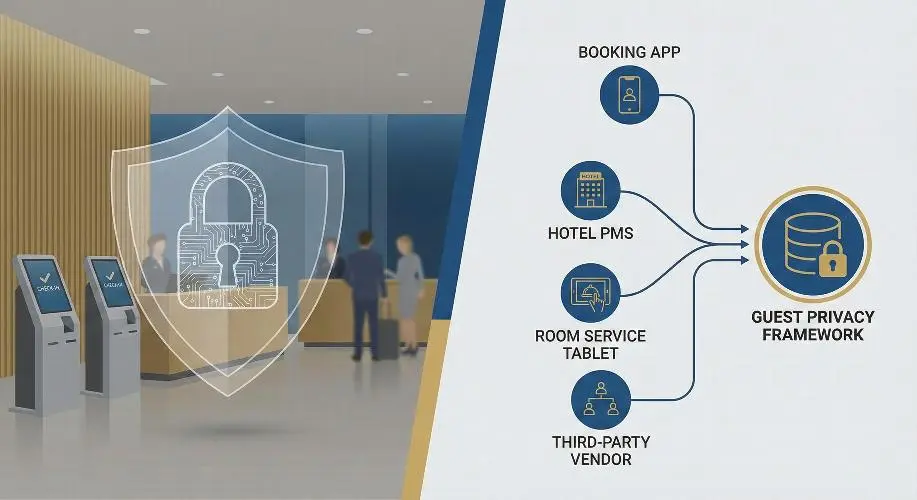
In the modern hotrld ecosystem privacy is no longer just about a warm welcome and a clean room; it is about the "customized experience." However, customization requires data. From the moment a guest browses a room to the post-stay survey, they leave a trail of digital footprints, needing hotel guest data journey mapping and privacy 2026
For hoteliers, the challenge is balancing this hyper-personalization with hyper-privacy. A breach doesn't just result in a fine (under GDPR, CCPA, etc.); it breaks the fundamental promise of safety that a hotel offers.
This guide maps the privacy risks across the entire guest lifecycle and outlines how to build a resilient privacy framework.
Phase I: Pre-Arrival & Reservations
The data journey begins long before the guest steps into the lobby.
1. The Booking Source: Direct vs. Third-Party
Data privacy integrity often depends on how the booking is made.
- Direct Booking (Website/App): The hotel is the primary Data Controller. You have full visibility over what is collected (name, card details, preferences).
- Risk: Insecure website forms (lack of HTTPS), storage of CVV codes (a violation of PCI-DSS), and cookies/trackers that follow the user without consent.
Third-Party Apps (OTAs - Booking.com, Expedia):
- The "Data Blindspot": OTAs often strip contact details (providing a masked email alias) to prevent hotels from "stealing" the customer. However, they pass on critical booking data.
- Risk: Data fragmentation. If a guest requests data deletion (Right to be Forgotten) from the OTA, the OTA might not effectively signal your PMS to delete the local copy, leading to compliance gaps.
2. Pre-Arrival Communications
- Concierge Outreach: Hotels often email asking for preferences (pillow type, arrival time).
- Risk: Using unencrypted email to ask for sensitive details (e.g., "Send us a copy of your passport for faster check-in"). Passport scans stored in a general email inbox are a high-value target for hackers.
Phase II: Check-In & The Front Desk
The intersection of physical security and digital data.
1. The Property Management System (PMS)
The PMS is the "heart" of hotel data. It stores history, spend, and preferences.
- The Risk of Over-Collection: Front desk staff often fill in optional fields "just in case."
- Privacy Principle: Data Minimization. Do not scan an ID unless required by local law. If you must scan it, does the system auto-delete the image after verification, or does it sit in a folder forever?
2. Verbal Privacy
- The "Lobby Echo": A common breach is the verbal confirmation of data.
- Scenario: "Mr. Smith, staying in room 402, I have your credit card ending in 1234?"
- Best Practice: Never speak the room number or personal details aloud in a busy line. Write the room number on the key jacket and point to it.
3. Payment Processing
- Authorization Forms: The paper "Credit Card Authorization Form" sent via fax or email is a massive liability.
- Solution: Use secure, tokenized links for third-party payments. Never store paper forms with full credit card numbers in a binder behind the desk.
Phase III: The Stay (Operational Data Risks)
This is the most complex phase, involving multiple departments and physical data exposure.
1. Housekeeping & Physical Data
Despite high-tech systems, housekeeping often runs on paper.
- The "Clipboard" Risk: Rooming lists often contain Guest Name, Room Number, Arrival/Departure dates, and sometimes VIP status or number of children.
- The Breach: A cart is left in the hallway while the attendant cleans a room. A passerby snaps a photo of the clipboard. They now know exactly who is in which room and when they are leaving (a physical security and privacy disaster).
- Mitigation: Digital tablets for staff or "blind" lists that show room tasks but redact guest names.
2. Room Service & Dietary Requirements (Sensitive Health Data)
- The Allergy Note: If a guest lists a "Severe Nut Allergy," this is classified as Health Data under GDPR and other stringent laws. It requires a higher level of protection (Explicit Consent).
- Workflow Risk: This data is often printed on a kitchen ticket ("Ticket #405: NO NUTS - GUEST ALLERGY").
- Disposal: These tickets are often thrown in open bins. They link a room number to a specific medical condition. Kitchen tickets must be shredded or de-identified.
3. Concierge & Third-Party Interactions
The Concierge is a data broker, sharing guest data with outsiders.
- Taxi/Limo Transfers: The concierge books a car. They text the driver: "Mr. Jones, Room 505, going to Airport."
- Risk: You have just shared PII with an unvetted third party (the driver) via an insecure channel (SMS).
- Excursions/Tours: Booking a tour often requires sharing passport numbers or ages.
- Vendor Vetting: Does the tour operator store this data securely? If the tour operator is breached, the guest will blame the hotel.
4. Hotel Technology (Wi-Fi & IoT)
- Wi-Fi Access: "Login with Facebook" or "Enter Email for Free Wi-Fi."
- Risk: Harvesting data for marketing without clear opt-out. Also, "DarkHotel" attacks (hackers using hotel Wi-Fi to target high-value business guests).
- Smart Rooms (Alexa/Google Home): These devices are "always listening." Guests must be informed they are there and given the option to mute/unplug them.
- Keyless Entry: App-based keys track exactly when a guest enters and leaves their room. This behavioral data is highly sensitive.
Phase IV: Post-Stay & Marketing
The relationship continues, but so does the liability.
1. The Survey & Reputation Management
- Third-Party Processors: Hotels use tools like Revinate or Medallia.
- The Feedback Loop: If a guest writes a review mentioning a staff member's name or another guest, the hotel has a duty to moderate that content if they republish it.
2. Retention & The "Right to be Forgotten"
- The Graveyard of Data: Hotels are notorious for keeping guest profiles from 1998 "just in case they return."
- Policy: Implement a retention schedule. If a guest hasn't stayed in 3 years, anonymize their profile (keep the financial stats, delete the name/email).
Building a Data Privacy Framework for Hotels
To move from "reactive" to "proactive," a hotel needs a structured framework.
1. The Data Audit (Data Mapping)
You cannot protect what you don't know you have. Create a map:
- Input: Website, OTA, Walk-in, Email.
- Storage: PMS, POS, CRM, Physical Binders, Housekeeping clipboards.
- Access: Who sees it? (Does the night porter need access to the full guest email list?)
2. Vendor Management Policy
Hotels rely on an ecosystem of vendors (florists, limo drivers, IT support).
- Action: Every vendor must sign a Data Processing Agreement (DPA). This contract legally binds them to protect your guests' data and notify you immediately if they are breached.
3. Operational Policy & Training
Privacy must be practical, not theoretical. Training should be role-specific:
- Front Desk Training:
- Do: Turn computer screens away from the lobby.
- Don't: Shout room numbers or leave ID cards on the counter.
- Housekeeping Training:
- Do: Keep rooming lists in a pocket, never on the cart. Return all lists to the manager for shredding at end of shift.
- Don't: Throw guest notes or printed emails found in rooms into general trash (creates dumpster diving risk).
- F&B Training:
- Do: Treat allergy information as confidential medical data.
- Don't: Leave POS tablets logged in and unattended on tables.
4. Incident Response Plan
Hotels are high targets for ransomware.
- The Plan: If the PMS goes down, do you have a manual backup that ensures privacy? (e.g., locking the manual registration papers in a safe, not leaving them on the desk).
- Notification: Who decides if guests need to be notified? (Legal/GM/PR).
Summary & Next Steps
Data privacy in hotels is not just an IT issue; it is an operational discipline involving every staff member from the bellman to the GM. A strong framework protects the guest's physical safety and digital identity simultaneously.
Next Up: Part 2: Restaurants & Dining. We will explore the specific risks of table management systems, menu engineering data, and the high-turnover environment of F&B.
Planning to update your hospitality privacy framework? or test your current framework click here for a free consultation and quote